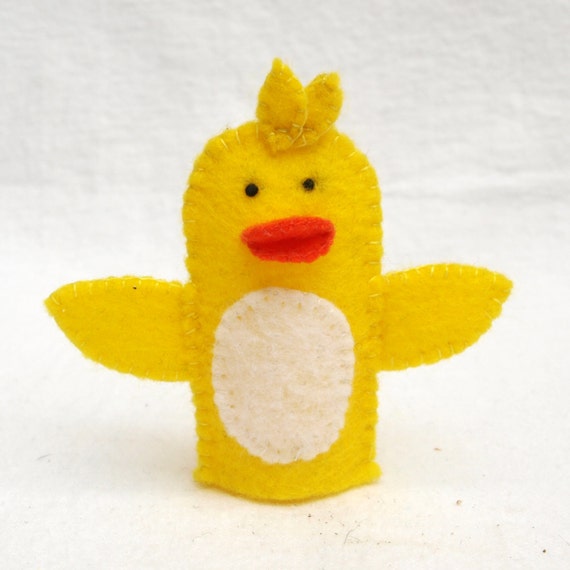
- Understand the meaning of a variety of gestures (greeting, beckoning a friend, offering food, waving goodbye, nodding in agreement).
- Use the gestures to interact with a puppet.
- Introduce a technique for imitating the actions of a bird.
- Develop vocal mimicry (using a clear, long drawn-out sound).
DEVELOPMENT OF THE ACTIVITY
1. Children are going to sit in a semicircle on chairs.We are gointo to tell the children that Bird has arrived to visit them, but if they want to see her they will have to call for her.
Show the children how to place their hands in front of their mouths to form a loudspeaker, and call "B-i-ird!". Ask the children to call with you and explain that Bird is shy and will not come out, so ask for ideas to encourage Bird to come out.
For that, show the children how to summon Bird (stretch out a hand genfly, palm upwards, beckon with your index finger...). Explain that it is very important to look straight at Bird if we want to call her: we always look at our friends when we talk to them.
Encourage the children to copy this gesture several times, and to say expressively: "Come here please, Bird, come here!"
When the children have complied, have Bird approach the children and bow. Next, ask the children why Bird bowed (Bird wanted to greet us but can only
talk by using gestures). Ask the children to return the bow, and then show the children how to feed Bird.
Then, help the children "feed Bird": they get some imaginary grain, hold it in an outstretched hand and offer it to Bird.
2. Place the puppet where it can "watch" the children, then ask the children to
stand up and imagine that they are little birds; they must 'flap their wings', (move outstretched arms up and down) and sing like Bird.
Ask the children to sit down again, bring out the puppet, and discuss the children's work: The Bird confirm that "the children were excellent, they sounded just like me!"
To finish, we are going to tell the children it is time for Bird to go, and introduce a ritual for departing guests e.g. thank the guest for coming, invite the guest to come again, have the guest accept the invitation, exchange polite bows, agree that the guest will come again, wave as you say goodbye.
RESOURCES